
Isaiah 12:2-6, Matthew 3:1-12
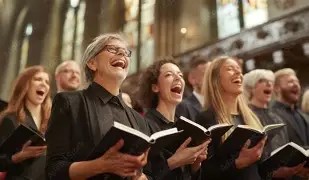 This evening we have heard sung one of my favourite psalms albeit not in its entirety. A psalm of praise of joy of thankfulness what more could one ask for at a service of Choral Evensong. Those first words ‘Make a joyful noise to God, all the earth’ set the tone for the entire psalm. And I think and hope that our organist and choir would agree with me that they did indeed make a truly joyful song to God and did indeed fill this church with praise and rejoicing as they sang.
 The idea of giving thanks to God either through the playing of musical instruments or through singing through goes back for thousands of years and the first Biblical reference to making music for God comes in Genesis where Jubal who was a descendent of Cain is described as the ancestor of all those who play the lyre and pipe. Thus, suggesting that music was a skill passed down through the generations and over time coming to play a significant role in both communal and religious life.
And from Genesis onwards there are reference to music making and singing throughout the Old Testament and most especially in the psalms. And the final psalm urges us to praise God with trumpet, lute and harp, with tambourine and dance, with strings and pipe and with loud clashing cymbals. And of course, we shouldn’t forget that the constant repetitive playing of trumpets brought down the walls of Jericho and it was David’s skill with the lyre that ensured King Saul could find escape from the evil spirits which plagued him while his Son Solomon composed over one thousand songs. And while the New Testament does not have quite so many references to music making and singing we do know for instance that at the conclusion of the Last Supper Jesus and his disciples sang a hymn and also that it was customary for Christ’s new followers to sing as testified by this verse from Ephesians: ‘Speak to one another with psalms, hymns and songs from the Spirit and make music from your heart to the Lord.’
And down the centuries that is what church goers have done as they came to worship. Make music from the heart Singing is deeply rooted in our nature and is found across all cultures and throughout history. But here it is interesting to be reminded that hymn singing was not permitted by the Church of England until 1820. Before that those hymns which were sung were often metrical and contained no musical notes and the singing was typically done by leaders who would sing one line which the congregation then repeated. Aren’t we thankful that today we have a hymn book filled with the most wonderful variety of hymns some very familiar and others we have still yet to learn.
And while in the peaceful and hallowed place we can hear music and singing to fill us with joy we must never forget the power of music and singing in times of great danger. We are told in Acts how Paul and Silas imprisoned in the innermost cell in Philippi prayed and sang hymns before their miraculous release when an earthquake struck and destroyed the prison. As the Titanic went down the gallant bandsmen continued to play and their last piece before they sank under the waves was the hymn Nearer my God to Thee. Another example is that of Edith Cavell who shortly before she was executed sang together with the British Chaplain ‘Abide with me’. And as a personal example of the power of singing my very young children and I were in a lift when the power failed. Never have I known blackness like it. I knew that I had to ensure the children didn’t freak out so tightly holding hands we proceeded to sing at the top of our voices. not hymns, they were too young for that, but nursery rhymes. And thank goodness the volume, probably completely off key that we managed to raise was sufficient for someone to recognise our plight and come to our rescue and not a frightened tear was shed.
But back to this evening and the hymns we have sung or will sing after this sermon. What effect have they had on us? Which one might we continue to sing or hum on our way home? The first one ‘O for a thousand tongues to sing pointed the way to our wish to give to God the maximum praise possible and though we couldn’t muster that number this evening we must never forget that our voices here on earth surely join with those of the angels. And if you go home and reread that hymn it is just full of praise, of wonder and of thanks to the Lord our God Verse five is to my mind a joyous sermon itself pointing to the healing that only God can give. ‘Hear him ye deaf; his praise you dumb, your loosened tongues employ; ye blind, behold your Saviour come; and leap ye lame for joy’. Lame or not whenever I sing those words they make me want to leap but I will restrain myself until I arrive home
And next we had ‘Blest are the pure in heart for they shall see our God’ echoing the promise of the sixth Beatitude. It is a hymn full of promise, full of hope that we can indeed find evidence of and be made aware God’s presence with us here on earth. Made aware that our souls can be places in which Christ may be found. And here I am reminded of the words of St John: ‘No one has ever seen God: if we love one another, God lives in us and his love is perfected in us.’ Words which along with those of the hymn surely urge us to look with genuine humility and unreserved love at just how we can follow the pattern of Christ’s life and as the last verse promises will find ourselves blessed.
And our last hymn today which I confess is new to me calls us to go forth from here in the peace of Christ and in joy bring his teaching, his love to the world. Three different hymns but each in their own way calling us to be people of joy, people of love, people of praise. People who will in one way or another in good times and in bad make a joyful noise to God. We won’t all have beautiful voices but that is not what matters what matters is that together we have indeed make a joyful noise to God and sung with all our heart to the glory of his name and given him glorious praise as psalm sixty-six urges us to do. And in so doing I pray that we will all discover this evening as we journey home that we have been truly blessed by God’s presence and known the truth of St Augustine’s words that to sing is to pray twice.